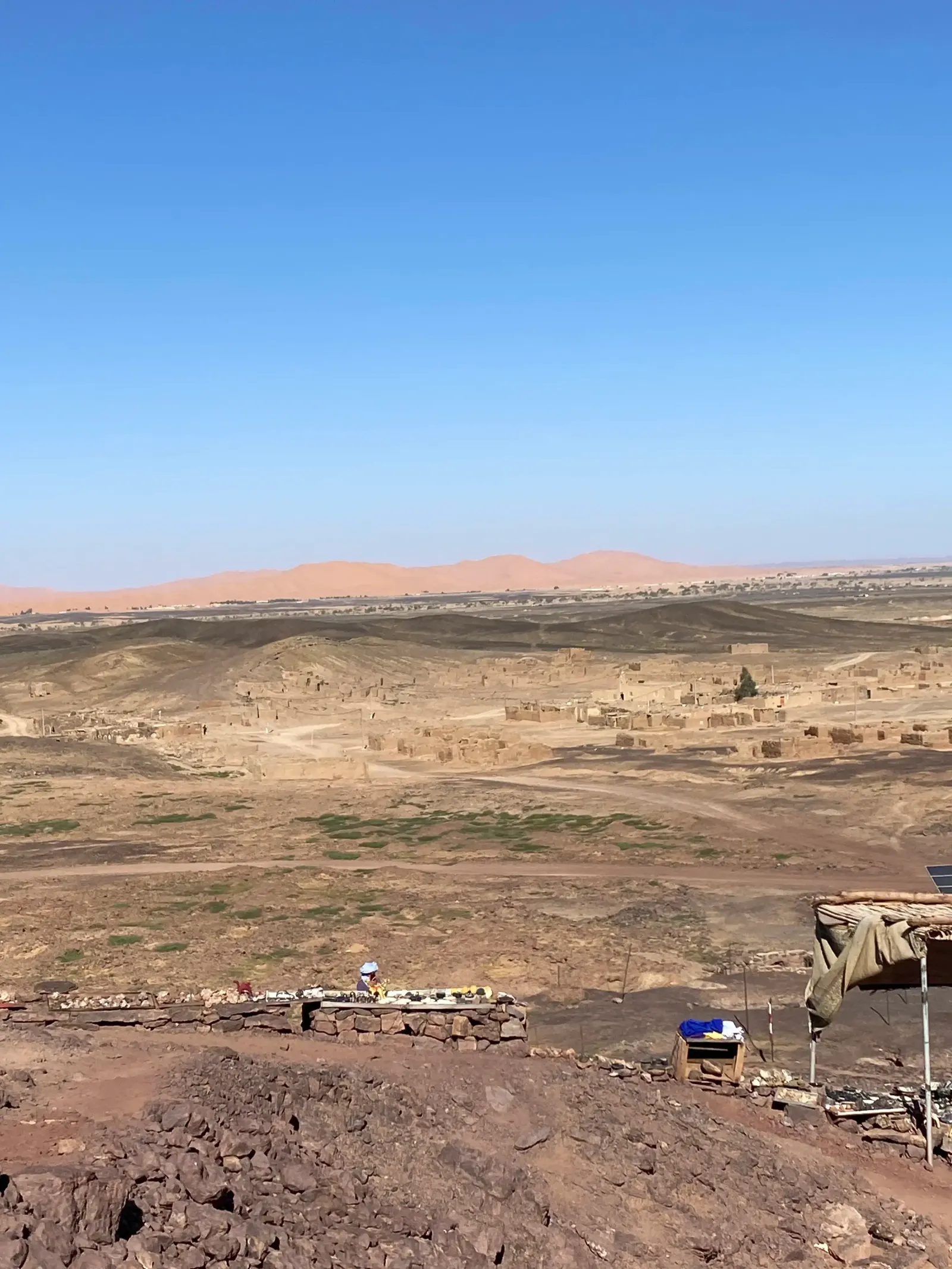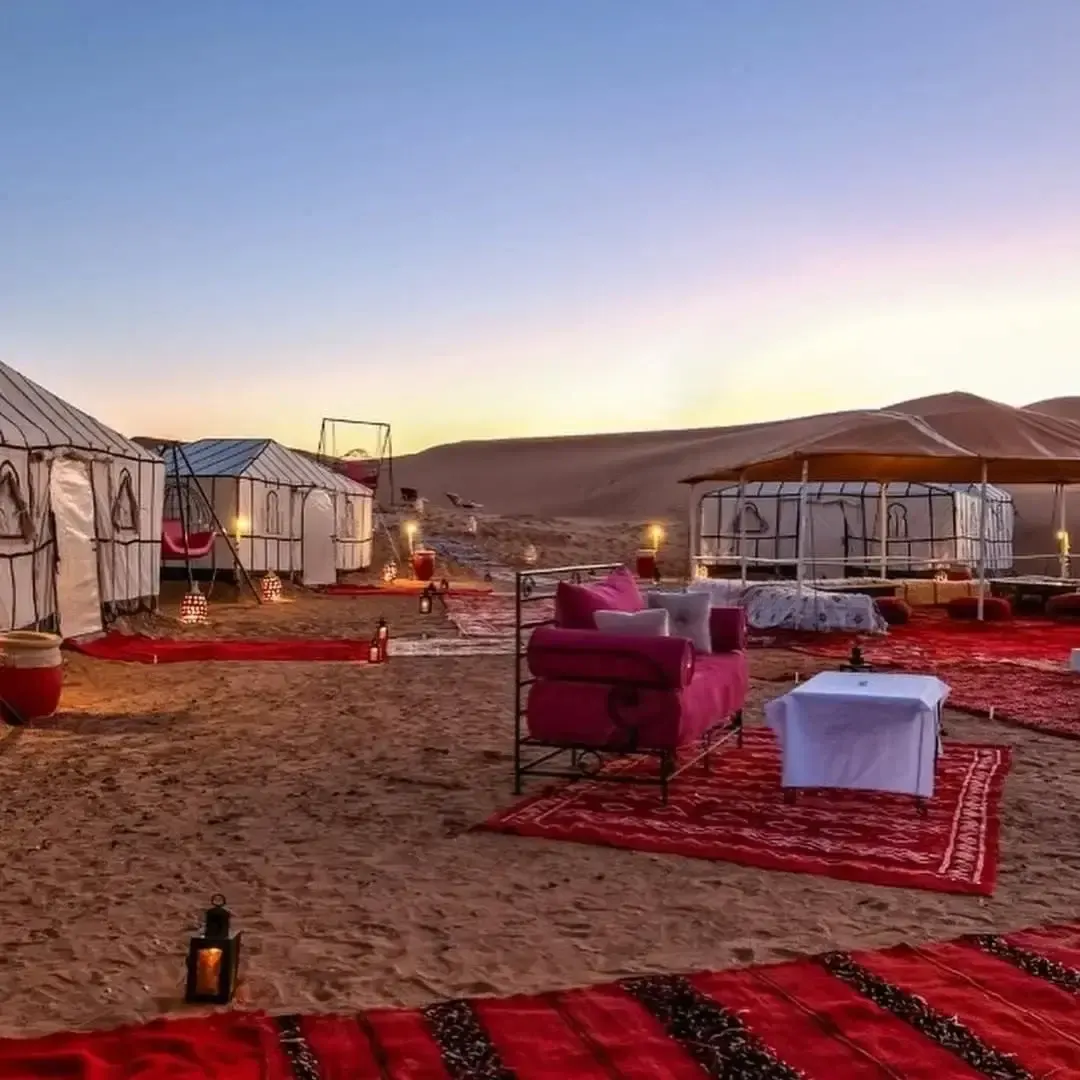

People come to Merzouga for the dunes. Many leave talking about a glass of tea poured from a great height, a stuffed bread baked in hot sand, or drums echoing across a village at dusk. The desert is not empty: it has been home to Amazigh communities, nomadic families and many other influences for centuries.
This guide is an introduction — not an encyclopaedia — written to help you understand a little of what you will see, taste and hear, and to be a good guest while you do.
Who are the Amazigh?
The Amazigh (plural Imazighen), often called Berbers in older English writing, are the Indigenous peoples of North Africa. Amazigh is generally understood to mean "free person", and it is the name many people prefer. Amazigh languages — known collectively as Tamazight, with regional varieties — are spoken across Morocco, and Tamazight is an official language of the country alongside Arabic. You will see its alphabet, Tifinagh, on road signs and public buildings.
Around Merzouga and the Tafilalet region, life has long been shaped by oases, palm groves, trade routes and the movement of nomadic herders. Today many families live in villages and towns, while some still move with their animals seasonally. Communities here are diverse, and identities overlap; your guide will be happy to talk about local history in more depth.
Hospitality
If there is one thing that defines desert culture for visitors, it is hospitality. Being offered tea is a gesture of welcome, and sharing food is central to social life. It is courteous to accept at least a glass — and perfectly fine to decline a third politely if you have had enough.
Food of the desert
Madfouna: the "Berber pizza"
The signature dish of the Merzouga area is madfouna (from an Arabic root meaning "buried"). It is a large, round, stuffed flatbread — often filled with minced meat, onions, spices, herbs and sometimes egg — that is traditionally baked in a clay oven or buried in hot embers or sand. Visitors often call it "Berber pizza", though locals may smile at the comparison. Vegetarian versions can usually be made on request.
Madfouna is best eaten hot and shared, torn by hand. It is often enjoyed at lunch in Merzouga or Rissani, and you can learn the process yourself in a bread-making experience.
Tagine
Named after the conical clay pot it is cooked in, a tagine is a slow-cooked stew of meat or vegetables with spices. Common versions include chicken with preserved lemon and olives, beef or lamb with prunes and almonds, and vegetable tagines heavy with carrots, courgettes and potatoes. In the desert, tagines are often cooked slowly over charcoal.
You will probably eat several tagines on a southern Morocco trip. If you would like to understand how they are made, a Moroccan cooking class is a hands-on way to learn.
Other things to try
- Couscous — traditionally a Friday family meal, steamed and served with vegetables and meat.
- Harira — a hearty tomato, lentil and chickpea soup, especially associated with breaking the fast during Ramadan.
- Khobz — everyday round bread, served with almost everything.
- Dates — the Tafilalet oases are famous for them; the market in Rissani is a good place to taste different varieties.
- Amlou — a rich spread of almonds, honey and argan oil, more common elsewhere in Morocco but sometimes found at breakfast.
If you have allergies or dietary needs — vegetarian, vegan, gluten-free or others — tell us when you book so we can pass them on. Camps and guesthouses are generally accommodating, though options in remote places can be simpler.
Mint tea: more than a drink
Moroccan mint tea — green tea brewed with fresh mint and, traditionally, plenty of sugar — is the drink of welcome everywhere you go. A few points of etiquette:
- It is poured from height. This aerates the tea and creates a light foam on top. It is also a bit of theatre.
- The host pours. Let them serve you; you do not need to help.
- Three glasses is a tradition. A well-known saying describes the first glass as gentle like life, the second strong like love and the third bitter like death. Do not feel obliged to drink all three, but accepting the first is polite.
- Ask for less sugar if you prefer — this is common now and not rude.
- Hold the glass near the rim. It is hot!
Want to see the whole ritual? Try a mint tea ceremony or a broader Amazigh cultural encounter.
Gnawa music in Khamlia
About 15 minutes' drive from Merzouga lies Khamlia, a village known for its Gnawa music. Gnawa traditions in Morocco trace back to people from sub-Saharan Africa, many of whom were brought north through historic trans-Saharan routes, including as enslaved people. Over generations, Gnawa music developed into a spiritual and musical tradition of its own, with deep rhythms played on the guembri (a three-stringed bass lute), large iron castanets called qraqeb, drums and call-and-response singing.
In Khamlia, musicians often welcome visitors to listen, share tea and sometimes join in the dancing. It is a joyful, hypnotic experience — and an important part of the region's living history. Contributions or purchases help support the musicians and their community; your guide can explain what is customary.
You can visit as part of a Khamlia village visit, a dedicated Gnawa music experience, or on our day trip to Rissani and Khamlia.
Visiting families and villages respectfully
Some of the most memorable moments of a desert trip involve meeting people in their homes, villages or nomadic camps. We only arrange these visits with the consent of the families, and with fair compensation for their time and hospitality. Access is never guaranteed — families have their own lives, and plans can change.
A few guidelines:
- Dress modestly, with shoulders and knees covered, especially in villages.
- Use your right hand for eating from a shared dish and for passing things.
- Remove your shoes if your hosts do so before entering a room or carpeted area.
- Ask before entering any space, and follow your guide's lead.
- Do not hand out sweets, pens or money to children. It can encourage begging and missing school. If you would like to contribute, ask us about appropriate ways to support local initiatives.
Respectful photography
The desert is wonderfully photogenic, and people are often happy to be photographed — but not always, and not everyone.
- Always ask first. A smile and a gesture towards your camera is usually enough to ask. Accept "no" gracefully.
- Be especially careful with women and children. Many women in rural areas prefer not to be photographed. Never photograph children without a parent's permission.
- Do not photograph people praying or during private religious moments.
- Respect "no photo" requests at homes and during music sessions if hosts ask.
- Think before you post. Consider how the person would feel seeing that image online.
- Some people may ask for a small payment for a photo, particularly in busy places. It is fine to decline and move on, or to agree beforehand.
For photography-focused trips, see our Sahara sunset photography experience, which concentrates on landscapes and light.
A few words to learn
Tamazight varieties differ by region, and Darija (Moroccan Arabic) is also widely spoken. Your guide will help with pronunciation, but trying even a word or two is always appreciated:
- Azul — hello (Tamazight)
- Tanmirt — thank you (Tamazight; varies by region)
- Salam alaikum — peace be upon you (a common greeting)
- Shukran — thank you (Darija/Arabic)
Experience the culture with us
Our team lives and works in this region, and sharing its culture with care matters to us. Whether you want to taste madfouna in Rissani, listen to Gnawa drums in Khamlia or spend an unhurried afternoon over tea, we can build it into your trip. Explore local food experiences, nomadic culture, or build your tour — and get in touch if you have any questions.