
 2 days
2-Day Mount Toubkal Summit Trek
A demanding two-day ascent of Jebel Toubkal (4,167 m) from Imlil with a qualified mountain guide – for fit, prepared hikers.
Contact us for a priceView details
This is Morocco for people who like to earn their views. You start with a guided two-day ascent of Jbel Toubkal, North Africa’s highest peak, then walk the Dades and Todra gorges, spend two nights among the Erg Chebbi dunes with optional quad biking and sandboarding, and head north to Fes and the trails around Chefchaouen before winding down on the Atlantic at Essaouira. A gentler village trek can replace the summit if you prefer.
Marrakech → Imlil → Toubkal → Imlil → Tizi n’Tichka → Ait Ben Haddou → Dades → Todra → Merzouga → Midelt → Ifrane → Fes → Chefchaouen → Rabat → Essaouira → Marrakech
Best for: Fit, active travellers who want hiking and outdoor adventure alongside the Sahara and Morocco’s great cities.
Driving times are approximate and exclude long stops; they vary with weather, roads and traffic.
You are met at Marrakech Menara airport and driven to your riad or hotel. The rest of the day is free. If you arrive early, stroll through the souks or watch evening fall over Jemaa el-Fna. In the evening we brief you on the trek: what to pack in your day bag, what can stay in Marrakech, and how the mountain days work. If you have any doubts about your fitness for the Toubkal ascent, this is the moment to switch to the gentler village trek — there is no penalty for choosing the easier option.
An early transfer takes us to Imlil, the trailhead village in the Toubkal National Park, where you meet your mountain guide and the mule team that carries the main bags. The trail climbs past Aroumd and the shrine of Sidi Chamharouch, then follows the rocky valley steadily upwards. The altitude gain is about 1,450 m, so the pace is slow and steady with plenty of breaks. You reach the refuge in the afternoon. Accommodation is basic and dormitory-style, with simple meals prepared by the refuge or your trekking team. Early to bed: tomorrow starts before dawn.
Setting off in the dark with headlamps, you climb the south cirque on scree and rocky paths, reaching the summit plateau for sunrise if conditions allow. On a clear day the view stretches across the High Atlas towards the Sahara. After photographs, you descend to the refuge for a hot drink and then continue all the way down to Imlil. This is a long, tiring day, and your guide may turn the group back if the weather or anyone’s condition requires it. In winter, ice and snow can make crampons and an ice axe necessary. Overnight in a guesthouse in Imlil with a well-earned dinner.
After a slow breakfast to rest your legs, we drive back towards Marrakech and then turn up the N9 into the High Atlas. The road climbs through villages and walnut groves to the Tizi n’Tichka pass at 2,260 m — a comfortable height after Toubkal. We descend to the arid south side and reach Ait Ben Haddou in the afternoon. A short, easy walk through the ksar and up to the granary on top is the only exertion today. Watching sunset over the earthen towers from your guesthouse terrace is a fine way to recover.
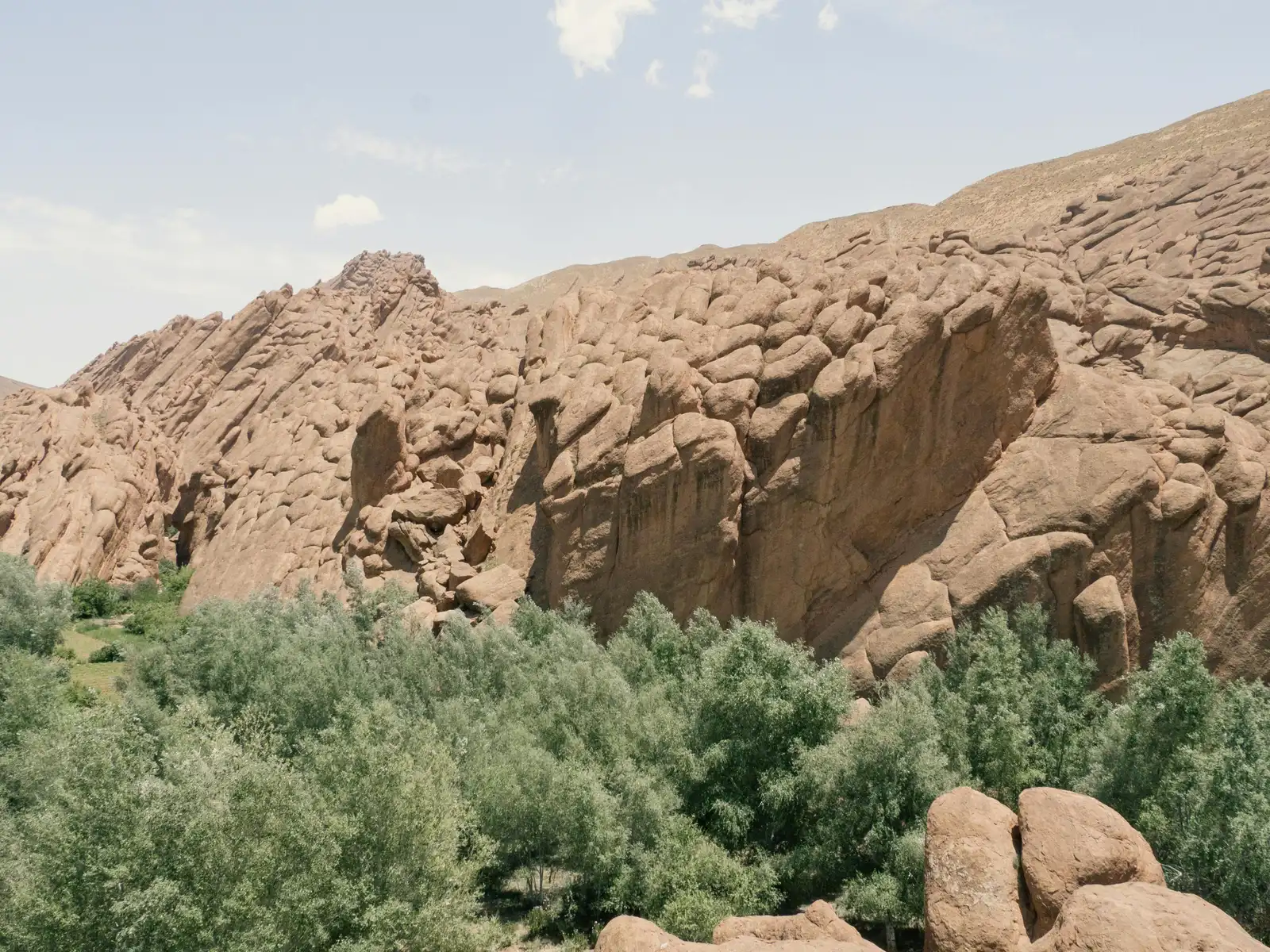
We pass Ouarzazate and the Skoura palm grove and follow the valley of kasbahs to Boumalne Dades. In the afternoon a local guide leads a walk in the Dades Gorge, through eroded red rock formations known locally as the ‘monkey fingers’, along dry side canyons and through a narrow passage where you may need to use your hands for balance. The route ends at a small village where the vehicle collects you. The terrain is uneven but not technical; a shorter version can be arranged if your legs are still tired from the mountains.
An hour’s drive brings us to Tinghir. Here you can hike a loop above the Todra Gorge, climbing past nomad shelters to a viewpoint and descending into the gorge itself between walls around 300 m high. After lunch we cross the open hamada towards Erfoud and reach Merzouga in the late afternoon. Swap the vehicle for a camel and ride about 1–1.5 hours into Erg Chebbi as the light fades. At camp there is dinner, music around the fire and, if the moon and weather allow, a sky full of stars.
Climb a dune for sunrise, then enjoy a full day based at the camp or in Merzouga. Sandboarding on a big dune is a favourite with active travellers. Optional quad biking, buggy driving or a 4x4 excursion around the edge of the erg can be booked for an extra cost, in designated areas only. In the afternoon you might visit Khamlia, a village with Gnawa musical traditions, or take a long walk into the dunes with a guide. A second night in the desert camp lets you enjoy the silence once the day visitors have gone.
After sunrise and breakfast, we start the long drive north. The road follows the Ziz Valley through Erfoud and Errachidia, with views over palm-filled gorges, then crosses the high plateau to Midelt, beneath the Jbel Ayachi massif. In the Middle Atlas we pass through cedar forests near Azrou, where Barbary macaques are often seen, and the Alpine-looking town of Ifrane. We arrive in Fes in the evening. This is a sitting-down day, with regular stops to stretch your legs. A good day to rest tired legs.
With a local guide you walk the lanes of Fes el-Bali, the great medieval medina. A typical day includes the Bou Inania Madrasa, the Nejjarine fountain, the exterior of the Al Quaraouiyine mosque and the Chouara tanneries from a terrace above the dye pits. Workshops of coppersmiths, weavers and tile-makers line the way. The afternoon is free; active travellers might walk up to the Merinid Tombs for sunset over the city, or relax with a hammam after the efforts of the past week.
We drive north through rolling farmland and olive groves into the Rif Mountains, arriving in Chefchaouen around lunchtime. The afternoon is free to explore the blue-washed medina, its small squares and the kasbah with its garden. Before sunset, take the path up to the Spanish Mosque, about 30 minutes uphill, for a view of the whole town against the mountains. Chefchaouen is relaxed and walkable, a good place to slow down for a day. In the evening, the main square fills with families and small cafés serve simple local dishes.
We drive to Akchour, at the edge of the Talassemtane National Park. With a local guide, you follow the river upstream through a green gorge, crossing on stepping stones and small bridges, to a series of waterfalls and pools. A separate branch of the trail leads to God’s Bridge, a natural rock arch high above the river. The paths are uneven, can be slippery and are busier at weekends and in summer, when swimming in the pools is popular. In the late afternoon we return to Chefchaouen.
Leaving the mountains, we drive south-west to Rabat, Morocco’s capital on the Atlantic. In the afternoon you can visit the Kasbah of the Udayas with its white-and-blue lanes and Andalusian garden, the Hassan Tower and the Mohammed V Mausoleum. In the evening the riverside promenade along the Bou Regreg is pleasant for a walk. Breaking the journey here keeps the next day’s drive to the coast manageable. This stop also lets you see a calmer, more modern side of Moroccan city life before the final days on the coast. The drive is largely on good roads with a lunch stop on the way.
A longer day on the motorway south, passing Casablanca and the plains of the Chaouia before turning west towards the coast through argan country, where you can stop at a women’s argan oil cooperative. We arrive in Essaouira in the afternoon. The sea breeze is refreshing after the inland heat; walk the ramparts of the Skala, watch the blue fishing boats come into the harbour and eat grilled fish at the port. We stop regularly for breaks, and lunch is usually taken along the way, so the long distance is broken into comfortable stages.
A free day on the coast. Essaouira is known for its steady winds, which make it a popular spot for kitesurfing and windsurfing; lessons can be booked locally with schools that provide equipment and instruction (on request). Horse or camel rides along the beach are also available. Otherwise, explore the relaxed medina, the woodworkers’ workshops beneath the ramparts and the art galleries, or simply enjoy a slow lunch by the sea after two weeks on the move. The beach is ideal for an easy recovery run or walk at sunrise.
After breakfast we drive back across the argan plains to Marrakech, arriving around midday or early afternoon. We take you directly to Marrakech Menara airport for your flight, so please choose an afternoon or evening departure. If you are staying on in Marrakech, we drop you at your hotel or riad instead, perhaps with time for a final look at the souks and Jemaa el-Fna before your journey home. The road is straightforward, with a coffee stop on the way and perhaps a last argan cooperative visit if you missed it earlier.
We confirm these details in your written quote:
Every night is booked in the comfort level you choose at booking. Budget means clean, simple guesthouses, auberges and family-run riads, some with shared or basic facilities. Standard means well-located mid-range hotels, riads and kasbah guesthouses with private bathrooms. Luxury means boutique riads, characterful kasbah hotels and premium properties. In the Sahara the same logic applies to the camp: a budget camp has simple tents and often shared washing facilities; a standard camp usually offers private tents, many with en-suite toilet and shower; a luxury camp has larger, furnished tents with en-suite bathrooms, more space and a more refined dinner. Exact properties are confirmed in writing before you travel and depend on availability. On the mountain, the Toubkal refuge is basic and shared whatever level you choose — bunks in dormitories, shared washrooms and limited hot water; the comfort level applies to all other nights. Sleeping bags or bedding arrangements are confirmed before departure.
On private departures you travel in an air-conditioned vehicle (typically a minivan or 4x4, depending on group size) with an English- or French-speaking driver who knows the route well. On the trek, a qualified mountain guide leads the group and mules carry overnight bags; your main luggage stays in the vehicle or in Marrakech. Breakfast and dinner are normally included on touring nights as part of the typical plan; lunches are usually taken at local restaurants of your choice along the way and paid locally. Vegetarian and other dietary needs can usually be catered for if mentioned at booking. Meals on the mountain are simple and filling. On city and leisure days only breakfast is included in the typical plan.
The Toubkal ascent is a strenuous, non-technical trek in summer, but at 4,167 m altitude sickness is possible: symptoms include headache, nausea and dizziness, and the only reliable remedy is to descend. You should be in good health, used to long hill walks and wear broken-in boots. In winter and early spring, snow and ice require crampons, an ice axe and suitable experience, and the mountain guide may change or cancel the ascent for safety. Travel insurance must cover trekking at this altitude. The Tizi n’Tichka pass climbs to 2,260 m on a well-surfaced but winding road with many hairpin bends; if you are prone to travel sickness, sit near the front and bring medication. Day 8 is 7–8 hours including stops, and Day 13 around 5–5.5 hours. Camel rides are gentle but not suitable for everyone: they are not recommended during pregnancy or for people with back, hip or serious joint problems, and riders above roughly 100–110 kg should tell us in advance (limits are set by the camel handlers — to be confirmed). Walking alongside the camels is always an option. Quad biking, buggies and 4x4 excursions take place only in designated areas, with a safety briefing, helmet and goggles; minimum ages are set by the operator — to be confirmed (typically 16+ to drive a quad alone, younger passengers only with an adult). Sandboarding is fun but falls are common; it is not advised for people with back or neck problems or during pregnancy. Desert temperatures swing widely: summer afternoons can exceed 40 °C and winter nights can drop close to freezing, so pack layers. The Akchour paths can be slippery after rain. Medina streets, kasbah stairs and soft sand are difficult for wheelchair users and people with limited mobility; tell us your needs and we will advise honestly what can be adapted.
Contact us for a price. Every trip is priced for your dates, group size, tour type and accommodation level. Send us your plan on WhatsApp or by email and we will send you the price.
[TO CONFIRM: payment method (e.g. bank transfer), deposit amount and balance deadline]. A booking is confirmed only after we confirm availability and payment arrangements in writing. We never ask for card details on this website.
[TO CONFIRM: cancellation windows and refund conditions]. See our Cancellation Policy. Read the policy, our booking terms and the Sahara tour FAQs.
You should be comfortable walking 6–10 hours a day on steep, rocky ground. No climbing skills are needed in summer, but altitude and the long descent make it demanding. If in doubt, choose the village trek alternative.
It is climbed year-round, but conditions vary widely. From roughly November to April snow and ice are common and winter equipment is needed. Your mountain guide decides on the day whether the summit is safe.
A two-day village trek from Imlil over a lower pass, sleeping in a local gîte. It offers fine mountain scenery without the high altitude.
No, they are optional extras booked locally. Sandboarding near the camp is usually available; equipment arrangements are confirmed at booking.
Yes. Longer Atlas treks, such as a circuit around the Toubkal massif, can be arranged on request with extra days.
2 daysA demanding two-day ascent of Jebel Toubkal (4,167 m) from Imlil with a qualified mountain guide – for fit, prepared hikers.
3 daysWalk between Amazigh villages in the High Atlas around Imlil, sleeping in a gîte or homestay, with mules for luggage on request.
 14 days
Two weeks covering the imperial cities, Chefchaouen, the Sahara, the Draa Valley, Marrakech and the Atlantic coast at Essaouira.